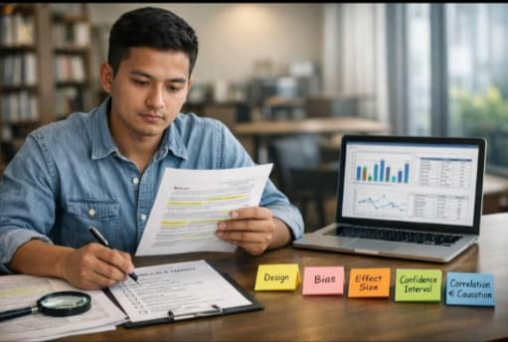
By The Public Lens Education Desk
Research helps students investigate questions, assess claims, and reach conclusions supported by evidence. These skills are useful not only for academic assignments but also for professional decisions and public discussions.
University assignments often require students to read existing studies, collect information, analyse findings, and present conclusions. These activities can appear to be requirements that must be completed for marks, but research skills have value beyond the classroom.
In professional environments, people regularly face questions that cannot be answered reliably through assumptions alone. Employers may need to understand customer behaviour, journalists may investigate a public claim, and health communicators may need to explain evidence about a particular issue.
The ability to ask clear questions and evaluate information can improve decisions in many fields.
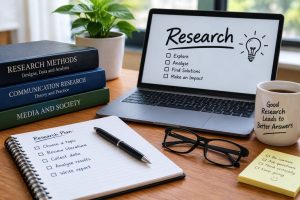 Start With a Clear Question
Good research begins with a question that can be investigated. A topic such as social media and students’ academic performance may be too broad to examine effectively without further definition.
A more focused question might investigate how a particular group of students uses social media during study periods or what students report about the relationship between online activity and concentration.
The precise question influences the research method, information required, and conclusions that can reasonably be drawn.
Choose Appropriate Sources and Methods
Different questions require different methods. Researchers may analyse documents, conduct interviews, use questionnaires, observe behaviour, or examine existing data.
The method should fit the question rather than being selected simply because it is familiar. A questionnaire may help gather responses from many people, but the quality of the results depends on the questions, sample, recruitment process, and honesty of respondents.
Interviews may provide detailed explanations of experiences, but a small number of interviews cannot automatically represent the views of an entire population.
Students need to understand what their chosen method can establish and where its limitations lie.
Distinguish Evidence From Assumption
Researchers sometimes enter a project with an expectation about what they will find. That expectation can influence how they interpret information or which results they pay attention to.
Responsible research requires openness to findings that do not support the original assumption. Evidence should be assessed consistently, and unexpected results should not be hidden simply because they complicate the argument.
Researchers should also avoid presenting correlation as proof that one factor caused another. Two things may occur together without one directly causing the other.
Ethics and Accuracy
Research involving people requires attention to consent, privacy, confidentiality, and potential harm. Participants should understand the purpose of the research and how their information will be used.
Students should also represent sources accurately, acknowledge other people’s work, and avoid inventing data or altering findings to produce a preferred result.
Where information is sensitive, researchers should follow institutional requirements and seek appropriate supervision.
Applying Research Skills Outside University
A journalist can use research skills to verify claims before publication. A public relations practitioner may investigate audience needs before designing a campaign. A business owner may study customer feedback before changing a product or service.
In each case, evidence can help identify assumptions that need to be tested and questions that require further investigation.
Research does not remove uncertainty from every decision. It provides a structured way to understand what is known, what remains unclear, and which conclusions are supported by the available information.
Research is not only an academic exercise. It develops habits of questioning, verification, analysis, and careful communication that are useful in professional and public life.
Students who understand how evidence is collected and interpreted are better equipped to assess claims, make informed decisions, and explain the reasons behind their conclusions.
Leave a Reply